
The Hidden Problem
Why Acidic Soil Sabotages Lawn Care in Ohio
Most homeowners pour money into fertilizer every year without realizing their soil cannot use it. In Northeast Ohio, soil pH typically falls between 5.5 and 6.2 — well below the 6.5 to 7.0 range where cool-season grasses absorb nutrients efficiently. At a pH of 5.5, your lawn can only access about 50% of the nitrogen, phosphorus, and potassium in your fertilizer. The rest locks into insoluble compounds in the clay and washes away.
This acidity is not a mystery. Ohio's glacial clay soils are naturally acidic, and several factors make it worse every year. Rainfall leaches calcium and magnesium from the topsoil. Nitrogen fertilizers — both professional-grade and store-bought — produce an acidifying reaction as they break down. Winter road salt residue that washes onto lawns along streets and driveways further acidifies soil by displacing calcium ions.
Lime treatment reverses this process by adding calcium carbonate (and often magnesium carbonate) back into the soil. The calcium raises pH gradually, and once the soil reaches the proper range, every other investment in your lawn — fertilizer, weed control, aeration, overseeding — becomes significantly more effective. For more details on our broader soil health approach, see our lime applications service overview.
The Science
How Lime Treatment Transforms Your Lawn
Lime is not fertilizer — it is a soil amendment that changes the chemistry of the soil to make fertilizer work. Here is what happens when we apply lime to an acidic Ohio lawn.
Nutrient Availability Increases
At proper pH levels, nitrogen, phosphorus, and potassium become soluble and accessible to grass roots. A lawn at pH 6.5 absorbs roughly twice the nutrients from the same fertilizer application as a lawn at pH 5.5. This means your existing fertilization program starts working harder without any additional cost or product changes.
Soil Biology Improves
Beneficial soil microorganisms — the bacteria and fungi that break down organic matter and cycle nutrients — are most active in the 6.0 to 7.0 pH range. Acidic soil suppresses microbial activity, reducing the natural decomposition of thatch and organic matter. Correcting pH awakens the biological engine in your soil that feeds your lawn naturally between fertilizer applications.
Weed Pressure Decreases
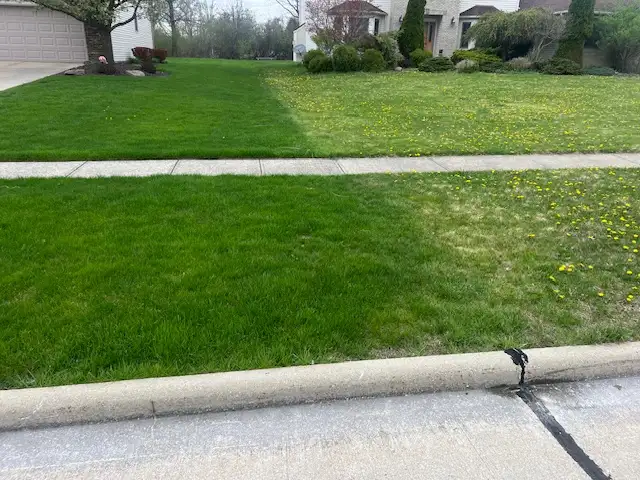
Many of the most persistent weeds in Ohio lawns — including moss, plantain, and sorrel — thrive in acidic conditions. When soil pH rises to the proper range, these acid-loving weeds lose their competitive advantage. Combined with targeted weed control treatments, lime applications reduce weed reinfestation by making the environment less hospitable to the weeds that keep coming back.
Local Soil Conditions
Why Northeast Ohio Lawns Need Lime More Than Most
The Cleveland metropolitan area sits on some of the most acidic lawn soil in the Midwest. Three factors combine to make lime treatment particularly important for properties across our service area.
Glacial clay dominates. The Wisconsin glacier deposited heavy clay soil across Cuyahoga, Medina, Lorain, and Summit counties. Clay particles have a high cation exchange capacity, meaning they hold onto hydrogen ions that drive pH downward. Sandy or loamy soils are easier to correct; Ohio's clay requires heavier lime applications and more time to shift.
Annual precipitation exceeds 39 inches. Cleveland receives roughly 39 inches of rain per year, and every rainfall event leaches calcium and magnesium from the topsoil into deeper layers where grass roots cannot reach. This natural acidification process accelerates during wet years and in areas with poor surface drainage — which describes most of the low-lying communities south of Cleveland.
Winter salt compounds the problem. Properties along main roads and near commercial areas in Independence, Parma, Middleburg Heights, and North Olmsted receive heavy salt exposure from November through March. Sodium chloride road salt displaces calcium from clay particles, driving pH lower. Spring lime applications on salt-exposed lawns are not optional — they are corrective maintenance.
Common Questions
Lime Treatment FAQ
Unlock Your Soil's Full Potential
Lime treatment makes every other lawn care investment work harder. Free estimates from a family-owned company serving Ohio since 1997.